

Engineering That Connects Theory To Industrial Practice

Calculate Flow Rate and Pipe Diameters with Technical Precision in Seconds
Calculate Flow Rate and Pipe Diameters with Technical Precision in Seconds
A straightforward calculator, no fluff — built for engineers who need speed and reliability in hydraulic calculations.
Description:
Avoid messy spreadsheets, random formulas, or trial-and-error approaches.
The calculator’s logic is simple: you enter the volume to be emptied or filled and the desired time, and it returns the ideal flow rate and pipe diameters based on velocities between 1 and 3 m/s.
Perfect for those who design, review, or size piping networks with seriousness, and want a quick check on whether the diameter is suitable for the project.
What you get with this software:
-
Automatic flow calculation converted into L/s, m³/h, GPM, and other units
-
Minimum and maximum diameters according to recommended technical velocities
-
Lightweight, fast, and easy-to-understand interface
-
Avoids common errors of undersizing or oversizing
-
Based on standards — not guesswork
Calculate Flow Rate and Pipe Diameters with Technical Precision in Seconds

Calculate Flow Rate and Pipe Diameters with Technical Precision in Seconds
A straightforward calculator, no fluff — built for engineers who need speed and reliability in hydraulic calculations.
Calculate Flow Rate and Pipe Diameters with Technical Precision in Seconds

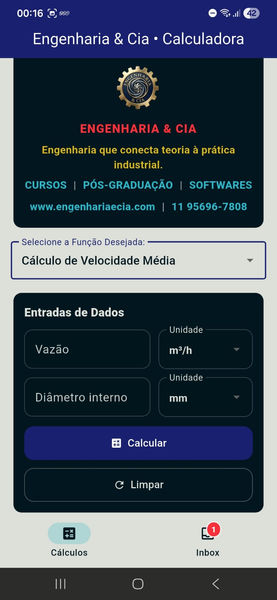

Calculate Flow Rate and Pipe Diameters with Technical Precision in Seconds
Free Flow and Diameter Calculation Software
Flow Rate & Internal Diameter Calculator: An Essential Tool for Pump Sizing
If you work with hydraulic systems, water & wastewater, industrial engineering, or pumping projects, you know that calculating flow rate and pipe internal diameter are fundamental steps in pump sizing.
With that in mind, we developed a smart, intuitive application capable of automating these calculations and generating professional reports quickly and accurately.
How does the app’s logic work?
The calculation starts from two basic inputs provided by the user:
-
The volume (V) to be pumped (in liters or cubic meters).
-
The time (t) needed to fill or empty the tank (in seconds, minutes, or hours).
With this information, the system automatically calculates the flow rate (Q) using the formula Q = V / t, where:
-
Q = Flow rate (m³/s)
-
V = Volume (m³)
-
t = Time (s)
Then the result is converted into the three main technical units:
-
L/s (liters per second): Q × 1000
-
L/min (liters per minute): Q × 1000 × 60
-
m³/h (cubic meters per hour): Q × 3600
Next, the recommended minimum and maximum internal diameters are calculated based on fluid velocity (typically between 1 m/s and 3 m/s, per good engineering practice).
We use the formula: D = √( 4 · Q / (π · v) )
Where:
-
D = Pipe internal diameter (m)
-
Q = Flow rate (m³/s)
-
v = Fluid velocity (between 1 m/s and 3 m/s, as recommended practice)
After that, D is converted to millimeters (mm) and also to decimal and fractional inches, making it easier to select standard commercial pipe sizes.
Example:
Suppose a tank with 2,000 liters needs to be emptied in 5 minutes.
First, convert the volume to cubic meters (2 m³) and the time to seconds (300 s), which gives a flow rate of approximately 0.0067 m³/s (or 6.67 L/s).
To determine the pipe’s internal diameter:
-
Using v = 3 m/s, the result is D ≈ 0.053 m, i.e., 53 mm.
-
Using v = 1 m/s, the result is D ≈ 0.092 m, i.e., 92 mm.
The application therefore provides a safe recommended diameter range for proper pipe selection.
Report generation
After the calculation, the app lets you generate a Word (.docx) report with all content auto-filled, keeping a professional, organized layout.
This greatly simplifies technical documentation and presenting the sizing to the client or project team.
Why is this tool useful?
Pump sizing depends directly on correct flow calculation and proper pipe selection.
Using an undersized pipe leads to high head losses, while an oversized pipe unnecessarily increases costs.
That’s why this calculator is a practical ally for:
-
Engineers and technicians
-
Industrial maintenance professionals
-
Engineering students
-
Hydraulics and water/wastewater consultants
